
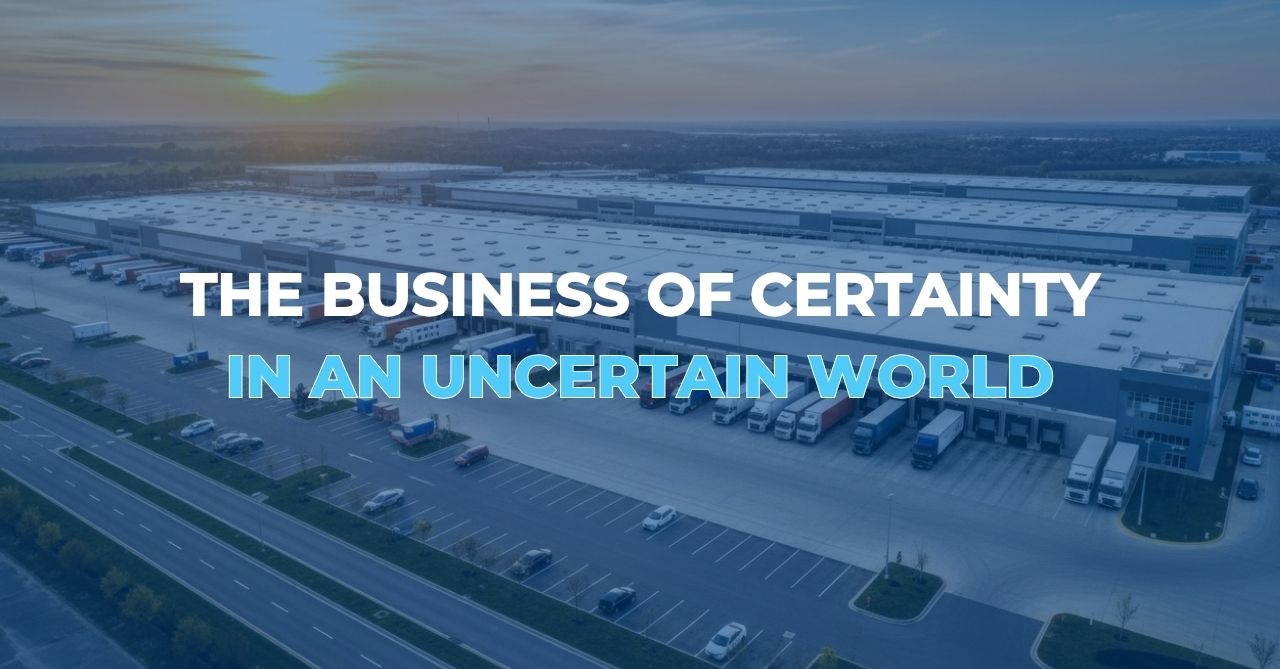
The last six years have not been a series of unrelated events. Any one of these events could be called an aberration. Six years of them, arriving one after another with barely a pause in between, are not an aberration. They are the operating environment.
The Business of Certainty in an Uncertain World
The last six years have not been a series of unrelated events.
COVID shut down demand, then broke supply. The Suez Canal blockage in 2021 held up twelve percent of global trade with one grounded ship. The war in Ukraine reshaped energy and grain markets in a week. The Red Sea and Houthi disruptions rerouted container traffic around Africa for months. Panama Canal drought cut transit capacity by a third. Tariff regimes rewrote sourcing math on short notice, more than once. The Strait of Hormuz has spent most of 2026 as a live geopolitical risk that shows up in every diesel invoice.
Any one of these could be called an aberration. Six years of them, arriving one after another with barely a pause in between, are not an aberration. They are the operating environment. Companies that are still running their businesses as if the next disruption is unlikely have not been paying attention. The ones that have been paying attention have been quietly changing how they operate, and those changes have real estate consequences that we think are still not fully appreciated by the broader market.
What Companies Actually Did
The behavioral shift is real and it is measurable.
Inventory strategy is the clearest example. The pre-2020 orthodoxy was “just in time.” The leaner the inventory, the more efficient the business. That orthodoxy is essentially over. McKinsey’s 2025 supply chain risk survey found that 45% of companies facing tariff-related disruption responded by increasing inventory buffers as their primary mitigation strategy. Aggregate inventory-to-sales ratios remain structurally higher than they were pre-COVID, even after the well-documented 2022-2023 destocking cycle. Companies that tried to return to pre-pandemic lean inventory got caught by the Red Sea disruption in 2024 and by tariff shocks in 2025. Most have stopped trying.
Sourcing diversification is the second shift. Companies that used to rely on a single overseas supplier now source from two or three regions. Manufacturers who used to run centralized distribution now run regional. Each of these decisions adds physical footprint requirements, warehouse space, yard space, staging capacity, because a more diversified supply chain has more nodes and more points where inventory has to sit.
Fleet operators made a related move. When transit times became unpredictable, staging capacity became insurance. This is often described as a port-adjacent story, but the bigger operational shift has been in the interior distribution network. A regional carrier moving freight along the I-24, I-40, or I-65 corridors doesn’t know whether a load will hit its Nashville or Louisville terminal on schedule, whether a driver will time out short of destination, or whether a customer’s dock will be open when the truck arrives. That variance has to be absorbed somewhere. Fleets absorb it by holding staging capacity closer to demand, in the interior markets where freight actually gets sorted, cross-docked, and repositioned. Under stable, predictable logistics, that staging capacity was a cost to be minimized. Under six years of disruption, it has become an operational necessity, and the value of yard space in the interior corridors that connect the coasts has moved with it.
And the reshoring conversation stopped being theoretical. Manufacturing capex flowing to the Southeast, Texas, and Mexico has been sustained across multiple administrations and multiple policy environments precisely because the underlying driver isn’t policy. It’s the recognition that long, single-threaded supply chains have become genuinely risky. The industrial demand this generates is not concentrated in one or two mega-projects; it is distributed across dozens of smaller manufacturing and distribution nodes in growth-market corridors.
The Real Estate Consequence
Each of these behavioral shifts translates directly into industrial real estate demand, but not evenly, and not in the places most institutional capital was pointed five years ago.
The demand that has been created is fragmented rather than concentrated. Buffer inventory has to sit closer to end demand, which means smaller facilities distributed across regional networks rather than mega-warehouses in a handful of national hubs. Sourcing diversification produces more distribution points, not bigger ones. Fleet staging capacity needs to be positioned near demand centers, which means Nashville, Charlotte, Atlanta, Dallas, and the corridors that connect them, not Ontario, California or the largest coastal hubs.
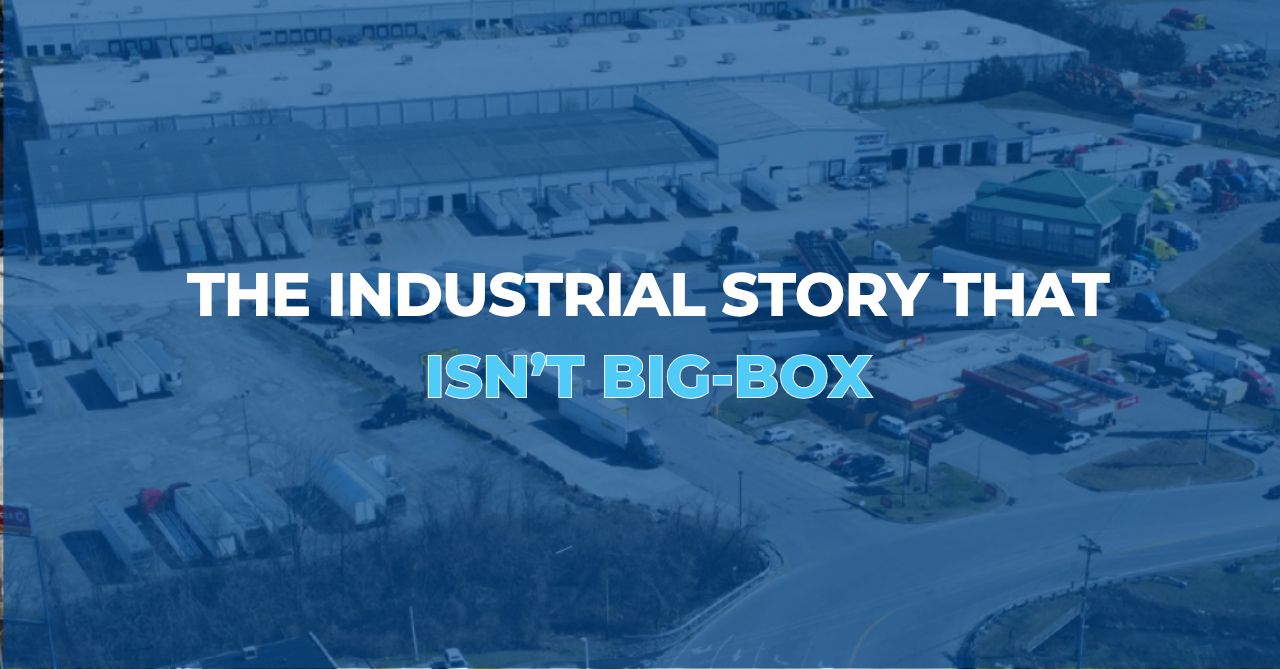
This is exactly the pattern the leasing data is showing. Small-bay leasing (under 50,000 square feet) accounts for 70 to 80 percent of all industrial lease activity, despite the fact that the sub-50,000-square-foot segment is only about 31 percent of total industrial inventory. Sub-50,000-square-foot vacancy is running at 3 to 4 percent nationally while the over-300,000-square-foot segment is near 10 percent. This is not a modest gap. It is a structural divergence that reflects a demand base that has broadened well beyond the e-commerce logistics tenant that dominated the last cycle.
Industrial outdoor storage sits alongside this shift as the physical infrastructure of operational flexibility. IOS is not really a real estate product in the traditional sense. It is capacity for logistics operators to handle variance. Higher and more volatile input costs, unpredictable transit times, and reshoring-driven fleet expansion have all pushed demand for staging capacity higher, in a sector where supply is structurally constrained by municipal reluctance to approve new sites. That constraint isn’t loosening. If anything, the political environment for new IOS approvals has gotten harder, not easier.
The tenant base has also changed, and the change matters. Five years ago, industrial demand was heavily concentrated in third-party logistics providers and e-commerce distribution. Today the demand base includes manufacturers holding buffer stock, distributors expanding regional presence, service companies staging equipment, and corporates operating their own logistics functions in-house. The base has broadened, which is why small-bay fundamentals have been so durable even through the rate cycle. When your tenant base isn’t dependent on any single end-market thesis, the fundamentals are more resilient to any single end-market disruption.
Why This Is Durable
The natural pushback to this argument is that supply chain disruption is a cyclical phenomenon that will normalize as specific conflicts resolve, as tariff regimes stabilize, and as logistics networks adapt. There is some truth to this. Any specific disruption does eventually resolve.
The reason we don’t think the underlying demand shift is cyclical is that companies have now been through enough disruptions to stop treating any of them as one-offs. The 2020 response to COVID could plausibly have been characterized as pandemic-specific. The 2021 response to Suez could have been treated as freak accident. By the time you’re through Ukraine, tariffs, Red Sea, Panama, and Hormuz, and by the time you’ve watched companies that unwound their COVID buffers get caught by the next shock, the behavioral shift stops being reactive and becomes structural. You are now underwriting your business for a world where disruption is the base case.
The specific companies making these decisions have also changed. In 2020, the buffer-inventory and sourcing-diversification decisions were being made largely by supply chain professionals responding to acute crises. By 2024 and 2025, they had moved up the org chart. CFOs and CEOs are now involved in these decisions because the risk exposure is material enough to affect earnings quality. Once a supply chain resilience strategy is embedded in enterprise risk management, in board-level reporting, and in insurance and financing decisions, it is very difficult to unwind, even in a hypothetical future where global logistics normalize for an extended period.
The reshoring flow is also structural rather than cyclical. Manufacturing investment decisions have long lead times and long payback periods; companies committing to Southeast or Mexico manufacturing capacity today are making 15-year decisions, not two-year ones. The industrial demand that flows from those decisions will land in the same growth-market corridors regardless of what the political environment looks like in 2028 or 2032.
What This Means for How We Underwrite
The way we think about Excelsior’s portfolio has always been anchored in three things: supply-constrained submarkets, basis meaningfully below replacement cost, and operational levers that don’t depend on the macro environment cooperating. The demand-side story we’ve been describing here reinforces all three, but it also adds a fourth: the tenant base for the assets we own is more durable than it was a cycle ago, and it is durable for reasons that are unlikely to reverse.
Our concentration in Southeast and Midwest growth markets isn’t just about population and job growth, though those matter. It’s about being where the reshoring and near-shoring activity is actually landing, in the corridors where distributed distribution networks and regional manufacturing footprints are getting built. Our focus on small-bay industrial and IOS isn’t just about supply-side constraints, though those matter too. It’s about being in the segments where the demand shift is concentrated, with tenant bases that have structural rather than cyclical drivers.
Basis discipline matters more, not less, in this environment. When the tenant demand story is durable, the temptation to chase it by paying up on acquisition is real. Discipline on entry basis is what keeps a good thesis from turning into a mediocre investment. We’re not the only ones who have noticed this demand shift, and pricing on the assets we’re competing for reflects that. Staying disciplined on what we’re willing to pay, and being patient enough to wait for the right deals rather than force the wrong ones, is how the thesis turns into returns rather than into a story we tell after the fact.
What This Adds Up To
The world has spent six years telling companies to buy operational flexibility. Companies have listened. The evidence is in inventory strategy, in sourcing decisions, in fleet operations, in manufacturing capex, and in the leasing data across every segment of the industrial market. The businesses that have made these decisions are not going to reverse them the next time a single shock resolves. They have been through too many.
The real estate that provides this flexibility, small-bay industrial in the corridors where the demand is landing, IOS as the physical infrastructure of logistics variance, medium-format distribution in reshoring-adjacent markets, is what we own and what we continue to acquire. We think the demand story that supports these assets is more durable than the market has priced in, and we think the sponsors best positioned for the next several years are the ones who understood the demand shift early and stayed disciplined on how they participated in it. That has been our approach. We expect it will continue to be.
Excelsior Capital is a private real estate investment firm focused on value-add acquisitions of industrial, medical office, and retail assets in growth markets across the Southeast and Midwest United States. Nothing in this commentary constitutes investment advice or a recommendation to buy or sell any security. Past performance is not indicative of future results.
Previous Articles






Excelsior Capital
A real estate private equity firm that owns and operates high quality multi-tenant office assets in emerging secondary markets.
Interested in learning more about Excelsior's investment opportunities?
Tag Cloud

Company
Investors
Excelsior Capital
104 Woodmont Blvd, Suite 120
Nashville, TN 37205
investors@excelsiorgp.com
Disclaimer: Under no circumstances should any information presented on this website be construed as an offer to sell, or solicitation of an offer to purchase any securities or other investments. This website does not contain the information that an investor should consider or evaluate to make a potential investment. Other materials related to investments in entities managed by Excelsior Capital are not available to the general public.