
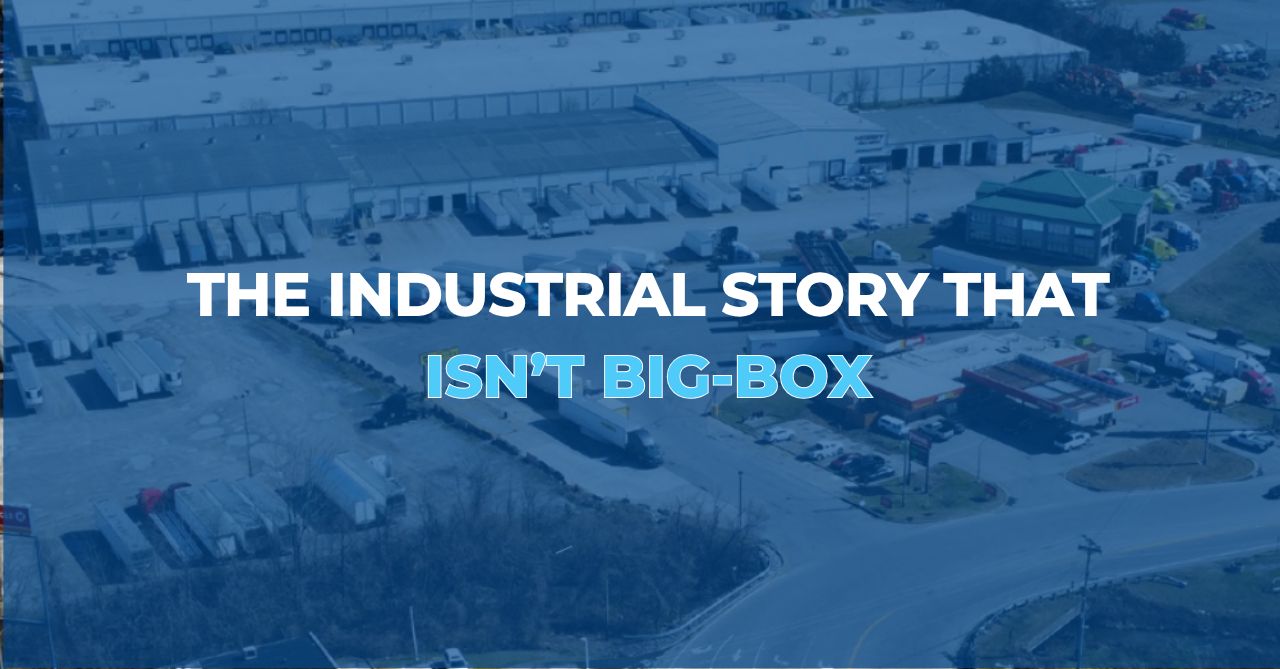
The Industrial Story That Isn’t Big-Box
The story we find more interesting — and the one that has quietly been the stronger fundamentals story for the past several years — is the segment below 100,000 square feet.
The Industrial Story That Isn’t Big-Box
When most investors hear “industrial real estate” today, they think of the same picture: a 500,000-square-foot bulk distribution warehouse, 36-foot clear heights, anchored by a national third-party logistics or a name-brand e-commerce tenant. That asset class has dominated industrial headlines for the better part of a decade. It also happens to be where the supply story has gotten genuinely difficult — vacancy in the over-300,000-square-foot segment is approaching 10% nationally, concessions are climbing, and new deliveries are finally catching up to demand in markets like Phoenix, Dallas, and Atlanta.
That isn’t the industrial story we’ve been concentrating capital around.
The story we find more interesting — and the one that has quietly been the stronger fundamentals story for the past several years — is the segment below 100,000 square feet. Shallow bay, small bay, multi-tenant flex, light industrial. Whatever name a particular broker prefers, it refers to the same thing: smaller-footprint, multi-tenant buildings serving regional and local users who need physical space to operate.
Combined with industrial outdoor storage — yards, fleet parking, equipment storage — it represents what we believe to be one of the most durable real estate setups available in the current market.
The Bifurcation
The data has been consistent for several quarters, and the gap continues to widen.
- National industrial vacancy sits in the 9-10% range. But that headline number hides two very different stories. For buildings over 300,000 square feet, vacancy is near 10% and rising as speculative 2022-2024 deliveries work their way through the market. For buildings under 50,000 square feet, vacancy is in the 3-4% range nationally, and in some submarkets it has been below 3% for over two years. Cushman & Wakefield’s Q1 2026 data put small-bay vacancy at roughly half the rate of larger industrial product across most major markets. CBRE’s most recent report observed that the gap between shallow-bay vacancy and the broader industrial market has been widening since 2017 and is now more than 250 basis points.
- The supply side explains why the gap is structural rather than cyclical. According to CoStar, only about 13% of industrial space currently under construction is below 200,000 square feet. The reason isn’t that developers don’t see the demand — they do — it’s that the economics haven’t worked. Small-bay construction runs roughly $140 per square foot today, nearly double the cost of a comparable big-box warehouse, because demising walls, individual loading doors, plumbing runs, and electrical drops scale unfavorably as you carve a building into smaller units. Institutional development capital has flowed almost exclusively to the larger-format product where the math works at scale. The result is an inventory base heavily skewed toward older buildings: nearly half of national shallow-bay inventory was built before 1980, and more than 80% before 2000. Product built since 2010 accounts for only about 5% of total inventory.
- Demand has gone the other direction. The tenant base — contractors, light manufacturers, regional distributors, trades, last-mile logistics — has been growing through every part of the rate cycle. These are businesses that need physical space, that serve local economies, and that can’t be replaced by remote work or e-commerce in the same way office demand can. They have been remarkably insensitive to the rate environment. The combination of constrained new supply and durable, fragmented demand has produced the kind of fundamentals that are increasingly rare in commercial real estate: rents that have grown more than 50% above 2010 levels, vacancy that has stayed range-bound at 3-5% even through the post-2022 disruption, and a tenant base that doesn’t depend on a single industry or end-market thesis.
Why the Southeast, and Why Nashville
Excelsior has concentrated its industrial activity in Southeast and Midwest growth markets for reasons that pre-date the current cycle — population growth, manufacturing reshoring, central distribution geography, business-friendly regulatory environments — and the small bay thesis maps cleanly onto that footprint. Nashville has emerged as one of the strongest industrial markets in the country, and within Nashville, the I-24 corridor southeast of the city has been the most active submarket for the kind of product we underwrite.
- The numbers tell the story. Nashville MSA industrial vacancy sat at 4.4% as of Q1 2026, more than 500 basis points below the national average. Asking rents have grown 31.5% above Q1 2023 levels. The Southeast submarket — which includes La Vergne, Murfreesboro, and the surrounding I-24 corridor — has been the most active node for new leasing, with smaller-tenant activity accounting for more than 75% of recent lease signings. CBRE notes that Nashville sits within a single day’s ground-delivery radius of over half the U.S. population, which has made it a structural winner in the supply-chain reconfiguration of the past five years.
- The submarket-level dynamics matter more than the MSA averages. La Vergne specifically benefits from direct I-24 access, proximity to BNA International Airport, and an industrial corridor that has absorbed a meaningful share of the MSA’s growth without the same speculative big-box overhang that has affected some peers. Constrained land in Davidson County and growing demand for industrial-zoned product have pushed activity outward into Rutherford and Wilson Counties, where La Vergne and Mt. Juliet have become the natural beneficiaries.
The IOS Complement
Running alongside the small bay story is a related but distinct asset class: Industrial Outdoor Storage, typically referred to as IOS.
IOS is exactly what it sounds like — fenced, paved or graveled yards used by businesses that need outdoor space to operate. Truck terminals and trailer parking. Contractor laydown yards. Equipment storage for construction, paving, landscaping, and utility companies. Container storage for importers and freight forwarders. The use cases are diverse, but the common thread is that the land is doing the work, not the building. A typical IOS site is low-coverage and the lease economics are anchored to acreage rather than square footage.
The supply-demand picture has been remarkable. Demand has been driven by e-commerce growth, last-mile delivery expansion, manufacturing reshoring, and the broader trucking fleet expansion that has accompanied all of the above. Supply has been structurally constrained because municipalities are reluctant to approve new IOS sites — they generate truck traffic, produce lower property tax revenue than warehouse development, and tend to face community opposition. The result is a sector where rents have grown roughly 30% since 2019 in many markets, vacancy has remained below 5% in most major metros, and institutional capital has begun to take notice in a way that wasn’t true even two years ago. Hamilton Lane has called IOS a $200 billion market opportunity; recent institutional transactions include Peakstone Realty Trust’s $490 million portfolio acquisition and Realterm’s $277 million purchase of 13 properties.
Nashville IOS has its own micro-story. New leases initiated between 2023 and 2025 have averaged roughly $8,000 per acre per month, with rent growth of approximately 50% since 2023. IOS-suitable land in the MSA averages around $1 million per acre, with prime locations in the La Vergne / Murfreesboro corridor trading meaningfully above that level.
What we find particularly interesting is that shallow bay and IOS pair naturally on the same site. A shallow bay building with surplus land that can be converted to or leased as IOS produces a meaningfully different return profile than either component would standalone. The building generates the base income; the yard adds a layer of land-driven income that requires minimal capital and faces a structurally constrained supply environment. The two together have been the most compelling combination we’ve found in this cycle.
How We Underwrite It
Our approach is consistent with the discipline we’ve discussed in prior posts. We’re not betting on cap rate compression. We’re not underwriting to an exit that requires the macro environment to cooperate. We’re looking for three things: a basis meaningfully below replacement cost, demonstrable supply constraints in the submarket, and a value-add lease-up or repositioning opportunity that gives us operational levers to pull regardless of where rates go.
- Basis is the floor. When we can acquire shallow bay product at a per-square-foot cost well below what it would take to build the same product today — and when construction costs are rising rather than falling — we have a meaningful margin of safety even in adverse scenarios. We’re not depending on the market to deliver returns; we’re depending on closing a real gap between in-place rents and market rents on a basis the market can’t easily replicate.
- Operational levers matter as much as basis. A vacant or under-leased shallow bay asset with light capex needs — roof work, parking lot repair, lighting upgrades, a partial office buildout, some yard regrading and gravel work — is the kind of asset where a focused operator can drive meaningful NOI growth through execution rather than market timing. The work is unglamorous. It’s also the work that compounds.
- Capital structure matters as well. We continue to underwrite to conservative leverage, model conservative cap rates at disposition, and avoid the kind of refinancing-dependent business plans that have caused real problems for sponsors who underwrote 2021-2022 deals to assumptions that haven’t held up.
A Recent Example
The acquisition we’re currently completing in La Vergne fits this thesis directly.
It’s a roughly 100,000-square-foot shallow bay industrial building on a 13-acre site, with approximately 5.7 acres of complementary industrial outdoor storage. The building is partially occupied, with credit tenancy already in place and a clear runway for the remaining lease-up. The IOS component is undeveloped at acquisition and represents a discrete value-add work stream in addition to the building lease-up. Our basis on the building component, after backing out the value of the IOS land at conservative market pricing, is meaningfully below the cost of new construction for comparable product in the submarket. The capex program is the kind of light value-add work we’ve executed on prior assets — roof repair, parking lot and yard regrading, lighting upgrades, end-cap office buildout, and the site work needed to bring the IOS component to market.
We’re not going to walk through the specific return projections in a public post. What we will say is that the thesis fit is clean: one of the strongest industrial submarkets in the country, the size segment where supply-demand is most favorable, a complementary IOS component in a sector where institutional capital is only beginning to allocate. The basis story is real. The value-add work is achievable. The submarket fundamentals are durable across the scenarios we underwrite.
What This Adds Up To
The big-box story has gotten most of the attention over the past decade because it has been where the institutional capital and the headline-grabbing tenants have lived. That has also been where the supply story has gotten difficult. The shallow bay and IOS segments have been quieter, less covered, and less competitive — and they have produced more durable fundamentals across the rate cycle precisely because the supply side has been structurally constrained rather than chasing demand.
We don’t think the next two years will reward sponsors who underwrote to cap rate compression on bulk distribution product in over-supplied markets. We think the next two years will reward operators who acquired below replacement cost in supply-constrained submarkets, who underwrote to flat assumptions, and who have the operational capability to execute value-add work on smaller, more fragmented assets. That’s the part of the industrial market we’ve been concentrating around. The acquisition we’re completing in La Vergne is the latest expression of that thesis, and we expect it won’t be the last.
Excelsior Capital is a private real estate investment firm focused on value-add acquisitions of industrial, medical office, and retail assets in growth markets across the Southeast and Midwest United States. Nothing in this commentary constitutes investment advice or a recommendation to buy or sell any security. Past performance is not indicative of future results.
Previous Articles






Excelsior Capital
A real estate private equity firm that owns and operates high quality multi-tenant office assets in emerging secondary markets.
Interested in learning more about Excelsior's investment opportunities?
Tag Cloud

Company
Investors
Excelsior Capital
104 Woodmont Blvd, Suite 120
Nashville, TN 37205
investors@excelsiorgp.com
Disclaimer: Under no circumstances should any information presented on this website be construed as an offer to sell, or solicitation of an offer to purchase any securities or other investments. This website does not contain the information that an investor should consider or evaluate to make a potential investment. Other materials related to investments in entities managed by Excelsior Capital are not available to the general public.